

Change Enablement by Design©
Designing Organizations That Can Adapt
Change used to be something you managed. A project with a start date and an end date. A rollout plan. A training session. A communication cascade. And then — hopefully — adoption.
That model made sense when change was occasional.
It doesn't anymore.
The organizations I work with today aren't dealing with one change at a time. They're navigating overlapping waves of new technology, shifting strategy, evolving talent expectations, and rising competitive pressure — all at once. And most of them are using change management tools that were built for a world that no longer exists.
At fluent, we think about this differently.
The Problem With "Managing" Change
Most change management approaches are built around implementation. Get the message out. Train people. Reinforce the behaviors. Measure adoption. Move on.
The underlying assumption is that resistance is the obstacle — and communication is the solution.
What I've seen over and over is that this framing misses the real issue. The problem isn't that people resist change. The problem is that most organizations aren't designed to absorb it.
When change lands in an environment without the right leadership alignment, the right context, or the right sense-making infrastructure, even well-intentioned initiatives stall. Not because people don't want to change — but because the organization isn't set up to support them through it.
That insight is what led us to develop Change Enablement by Design©.
A Different Way of Thinking About Change
Our approach is grounded in a simple but important idea: Sustainable change happens when organizations are intentionally designed to support human acceptance — not just implementation.
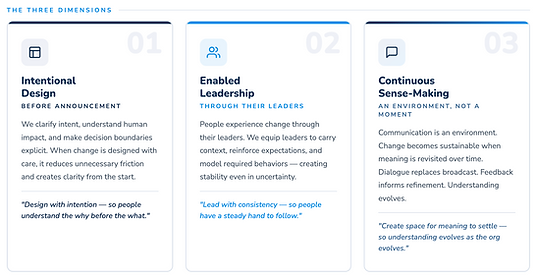
We think about sustainable change through three dimensions that work together:
Sustainable Change = Intentional Design × Enabled Leadership × Continuous Sense-Making
These aren't phases or steps.
They're ongoing conditions — the environment your organization needs to make change more absorbable, more durable, and less disruptive over time.
Intentional Design
Before change is announced, it has to be thoughtfully designed.
That sounds obvious, but in practice, it's where most organizations cut corners. The announcement goes out before the implications have been fully thought through. Leaders are asked to carry a message they don't fully understand yet. And employees are left filling in gaps with their own assumptions — which rarely go in the direction you'd hope.
Intentional design means clarifying intent before you communicate, understanding the human impact before you launch, and making decision boundaries explicit so leaders know what they can and can't flex on.
When change is designed with that kind of care upfront, it dramatically reduces the friction that slows adoption down the road.
Enabled Leadership
People don't experience change through org charts or email announcements. They experience it through their managers.
This is one of the most consistent findings in our work. When leaders are aligned, prepared, and equipped to carry context — change feels navigable, even when it's hard. When leaders are confused, caught off guard, or sending mixed signals — even straightforward changes become destabilizing.
Enabling leadership isn't about scripting talking points. It's about making sure the people closest to your workforce understand the why, can reinforce expectations clearly, and can model the behaviors the change actually requires.
That kind of leadership alignment doesn't happen automatically. It has to be built.
Continuous Sense-Making
This is the dimension that most change approaches get wrong.
Communication is typically treated as a moment — an announcement, a town hall, a series of emails. But meaning doesn't settle in a moment. It settles over time, through repeated exposure, dialogue, and the opportunity to ask questions and get real answers.
What we've found is that change becomes sustainable when organizations create an ongoing environment for sense-making — where dialogue replaces broadcast, feedback actually informs how things evolve, and understanding deepens as the organization moves forward.
This isn't just good communication practice. It's grounded in how people actually process uncertainty. Under stress, our cognitive bandwidth narrows. We need psychological safety to adapt. We seek clarity and coherence — and when we don't find it, we disengage.
Change Enablement by Design© is built around those human realities.
Where This Applies
I want to be clear that this isn't an approach reserved for massive enterprise transformations. The principles scale.
We've applied this thinking across:
-
New ways of working and operating model redesigns
-
Leadership behavior and culture shifts
-
Technology and product transformations
-
Process, policy, and structural changes
From targeted adjustments to organization-wide evolution, the core principle stays the same: design with intention, lead with consistency, and create the space for meaning to settle.
That's how change stops being something you do to an organization — and starts being something the organization can actually do.
If your organization is navigating change that isn't landing the way you expected — or if you're anticipating something significant on the horizon — we'd welcome a conversation. It's exactly the kind of work we do at fluent.
Author
Neville Poole
CEO of fluent
