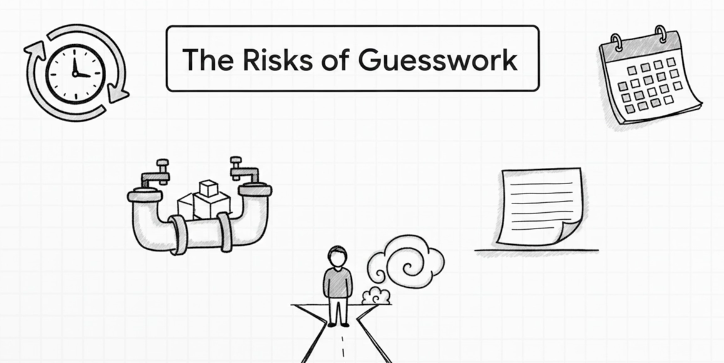
Have you ever had that feeling like you're working completely in the dark? You can tell things could be better, but for the life of you, you can't quite pinpoint why everything feels stuck. This article shows you how to move from frustrating guesswork to genuine insight, using a few simple signals to understand how your team is doing.
Metrics ARE:
● Signals that help us understand how our system is working
● A way to reduce surprises and improve predictability by giving us inputs for retrospectives
● Inputs that help us run better experiments
Predictability improves when we:
● Match throughput to capacity
● Reduce variability
● Shorten feedback loops
Metrics help us see those things.
A Simple Way to Think About Metrics
Instead of asking:
“Are we doing well or poorly?”
Ask:
“What is this telling us about how our system behaves?”
That shift changes everything.
What’s at Risk if We Don’t Measure?
If we’re not using metrics, we’re still making decisions—just without signals.
That often leads to:
● Decisions based on perception instead of patterns- We rely on what we feel instead of what we can observe.
● Repeated challenges without clear root causes- Work gets stuck, plans slip, but it’s hard to see why.
● Reduced predictability- Surprises increase because we can’t see trends forming early
● Hidden system constraints- Bottlenecks, dependencies, and overload remain invisible
● Less effective improvement efforts
We try changes, but don’t know if they actually helped. Without metrics, improvement becomes guesswork instead of learning. You can try all the new things you want, but you have no real way of knowing if they actually helped.
5 Team-Level Metrics You Can Start Using Now
Keep it simple. We don’t need perfect data—just consistent signals.
- Committed vs Completed
How much did we plan vs actually finish?
Signal: Are we overcommitting or undercommitting?
If this is inconsistent → our planning or readiness may need attention - Cycle Time
How long does it take for work to go from “in progress” to “done”?
If cycle time is increasing:
● Work may be too big
● Dependencies or blockers may be slowing us down - Work in Progress (WIP)
How many items are we working on at the same time?
Rising WIP is often a signal of:
● Context switching
● Bottlenecks
● Hidden work
(And a leading indicator of unpredictability) - Blockers / Dependencies
How often is work getting stuck?
Track:
● Number of blocked items per sprint
● Time spent blocked
Signal:
Where our system—not our people—is struggling - Escaped Defects (Quality Signal)
Bugs found after release
If increasing:
● Feedback loops may be too slow
● Definition of Done may need strengthening
Looking Ahead: Experiments
These metrics will become inputs for team experiments.
For example:
● “Our cycle time is increasing → Let’s try smaller stories”
● “We’re overcommitting → Let’s test a clearer Definition of Ready”
● “Too many blockers → Let’s visualize dependencies earlier”
Team Reflection
Take a few minutes this week and discuss:
● Which of these metrics do we already have?
● Which one would give us the most insight right now?
● What might it be telling us about our system?
Final Thought
If you are tired of the same problems happening over and over and the root cause is a total mystery, then you may be working without clear feedback loops. Qualitative data tells us what is happening but not why it is happening. Metrics don’t tell us what to do- they help us ask better questions. And better questions lead to better experiments. Better experiments inform opportunities to improve in shorter cycles.